Swift Hackathon 2026: Discover the winning teams
This year’s Swift Hackathon saw teams from around the world sharing new ideas to explore how standards can accelerate the adoption of digital assets.
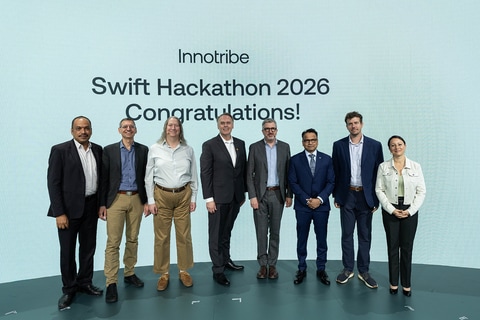
We’re thrilled to name the winners of the 2026 Swift Hackathon: Standard Chartered, winner of the Business Challenge, and Pictet, winner of the Technical Challenge.
Hot on their heels were two outstanding runners-up: Chainlink Labs in the Business Challenge, and Suntec Business Solutions Ptv ltd in the Technical Challenge.
We’d also like to give an honourable mention to TD Bank and Kaiko for their creative approaches and strong execution in each respective challenge. Congratulations to all the winners and participants for delivering truly innovative solutions.
This year, under the theme of ‘Scaling digital assets through standards’, Hackathon teams from across the industry explored how standards, interoperability and practical implementation can help support the next phase of digital asset adoption.
Teams were invited to tackle one or both of two challenges:
- The Business Challenge: Who does what in a tokenised world?
- The Technical Challenge: Cracking the control conundrum
The Business Challenge focused on how existing market roles and lifecycle activities can be aligned to standards in a tokenised asset environment. The Technical Challenge explored how reusable, standards-based control functions can operate consistently across digital asset platforms, regardless of asset type.
We caught up with our winning teams to learn how they approached these challenges and developed their winning solutions.
Business Challenge winner
Standard Chartered 🏆
For the team at Standard Chartered, the challenge presented an opportunity to tackle a familiar problem through a new lens.
Their solution, ‘Tokenised Receivables Factoring’, is a digital version of an established trade finance process. The solution is built around one of the most common challenges in international trade: suppliers often need to wait weeks or months before receiving payment for goods they have already delivered. To bridge this gap, banks can purchase those receivables, providing immediate liquidity while assuming the associated payment risk.
The process becomes more complex when buyers and suppliers are in different countries. In these scenarios, financial institutions must coordinate across jurisdictions, creating additional operational and risk-management challenges. Here, the Standard Chartered team saw an opportunity to use digital assets and standards by applying a “simplify and modernise” approach.
Through the tokenisation of invoices, all participants can gain access to the same trusted information in real time, reducing manual intervention while increasing transparency, reconciliation and efficiency.
Building adoption through standards
A major focus for the team was ensuring that the solution could support interoperability and scale.
"Our biggest learning was that the real challenge in scaling digital assets is not the technology itself but achieving adoption,” said Sudipta Pal, Chief Product Owner, Trade Data, Standard Chartered.
"That was a significant insight for our team and has shaped our thinking about the future industry adoption of digital assets," added Sanchit Aggarwal, Payment Solutions, Standard Chartered.
Rather than creating a new ecosystem, they chose to build on existing industry standards. The solution combines ISO 20022 messaging, GLEIF's Verifiable Legal Entity Identifier and established legal frameworks already used by the trade finance community.
“We discovered that by combining global standards, digital identities and tokenisation with existing legal agreements and operating models, it’s possible to create a scalable solution that delivers innovation without forcing market participants to abandon established processes,” added Suresh Babu Pagadala, Senior Solutions Architect, Standard Chartered.
Technical Challenge winner
Pictet🏆
The Technical Challenge asked participants to address a fundamental industry question: how can control functions operate consistently across different digital asset platforms and networks?
For the team at Pictet, the challenge immediately resonated. And like many Hackathon teams, their first ideas were ambitious. "At the beginning, we tried to do something very technical, trying to solve all the problems of the world through blockchain and digital assets,” said Matteo Castelli, DevOps Engineer, Pictet.
But the team soon realised that practical implementation mattered more than technical complexity. The result was ‘Control Passport’, a reusable validation and attestation framework designed to allow payments and tokenised transactions to carry standardised, verifiable evidence of the controls that have been applied to them.
Organisations often struggle to demonstrate exactly which checks were performed, by whom and under which version of a particular control. Control Passport creates a portable and verifiable record of these validation activities, allowing institutions, counterparties and auditors to confirm that appropriate controls have been applied.
The solution allows control information to be attached directly to a payment message, creating greater transparency while reducing duplication across networks. It also distinguishes between public controls, published by authorities and shared institutions, and private controls defined internally by banks.
Privacy by design
A core principle of the solution was protecting sensitive information. Rather than exposing transaction information on a shared blockchain, the team designed a framework that allows institutions to verify controls while keeping payment data private.
That focus on practicality became one of the solution's defining strengths. The team's goal was something more grounded: "Even if it would require a lot of collaboration across multiple parties, we believe our solution could be implemented in the real world,” said Rodolfo Milos, Product Owner Interbank Messaging, Pictet.
Pictet's victory was made even more impressive by the circumstances in which the solution was developed. "We basically discovered the Hackathon four days before the deadline,” added Castelli.
Reflecting on the experience, Castelli highlighted what made the Hackathon special: "It was really fun to work on creating an interesting solution outside of our daily job."
Looking ahead
This year’s Swift Hackathon highlighted how the next phase of digital asset adoption will depend not only on technology, but also on standards, interoperability and practical implementation. As digital assets continue to move towards broader adoption, the focus is increasingly on enabling scale – whether across institutions, platforms and markets.
By combining innovation with real-world applicability, this year’s winners showed how the industry can build scalable foundations for the future of digital assets.