Key insights from the Policy Lab at Sibos 2026
The second year of the Policy Lab, held at Sibos 2026 in Miami, saw policymakers, central bankers, regulators and industry leaders come together to address a defining challenge for the financial system: how to balance resilience with efficiency.
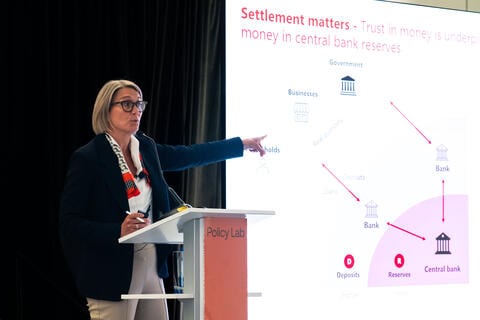
Across two days of discussion at the Policy Lab, which combines invitation-only and open discussions to encourage dialogue across the financial ecosystem, participants explored the growing focus on strategic autonomy due to geopolitical fragmentation, the ongoing imperative to improve payment and securities market efficiency and the implications for resilience – all against a backdrop of AI-driven uncertainty.
While the topics varied, a common theme emerged: progress will depend on collaboration, interoperability and shared standards.
Balancing AI opportunity and risk
The first day of the Policy Lab focused on the challenges shaping resilience and strategic autonomy in an increasingly uncertain world.
Artificial intelligence (AI) featured prominently throughout discussions. Participants agreed that AI is rapidly moving from experimentation to implementation across financial services, as firms seek out productivity gains.
Yet despite the excitement surrounding the technology – and potential applications for Agentic AI – discussions reflected a shared recognition that adoption is still in its early stages and that significant challenges remain.
Attention quickly turned to risks associated with AI. Concerns included data security, model ‘hallucinations’, the potential erosion of institutional knowledge and the possibility that increasingly interconnected autonomous systems could amplify operational failures.
A recurring theme was that regulation should focus less on AI itself and more on how it is deployed.
Participants agreed that financial institutions remain responsible for the outcomes generated by AI systems and must put in place appropriate controls, oversight and safeguards. At the same time, speakers stressed that industry and regulators must work together to find common approaches to support innovation while managing risk.
Rethinking resilience in a fragmented landscape
The conversation around AI also highlighted a broader question of resilience. While many governments are pursuing greater technological sovereignty, participants noted the reality that critical technologies often rely on deep, global supply chains and complex international dependencies.
Those dependencies are creating new vulnerabilities. As technology, geopolitics and finance become increasingly interconnected, resilience is no longer something institutions can achieve alone.
Participants pointed to a growing recognition that collaborative exercises, coordinated testing and information-sharing are becoming essential components of industry resilience strategies.
Collective action was equally evident in discussions on economic crime. Participants explored how financial crime, fraud and sanctions-related risks have evolved from operational compliance challenges into broader economic and national security concerns.
Today’s criminal networks freely operate across borders, exploiting fragmentation between jurisdictions and regulatory frameworks. Tackling these threats demands stronger cooperation between financial institutions, public authorities and law enforcement agencies. This reality has led to the financial industry collaborating more closely on stress tests that simulate payment-system outages and other mass disruption scenarios.
Efficiency through interoperability
While Day 1 of the Policy Lab focused on resilience and security, Day 2 turned to the question of how financial markets can remain efficient in an increasingly fragmented landscape.
Cross-border payments remained a central topic. Participants acknowledged the significant progress made under the G20 goals for enhancing cross-border payments, particularly around speed, transparency and adoption of common standards. Yet there was also broad agreement that challenges remain if the industry's long-term ambitions are to be realised.
Particular attention was given to the ‘first mile’ and ‘last mile’ of payment journeys, which continue to generate friction despite improvements elsewhere in the full payment chain. Discussions reinforced the need for continued work at both industry and jurisdictional levels to address these bottlenecks.
A key takeaway was that future progress depends on interoperability. The reality is that there is no single model for cross-border payments, but a range of approaches that increasingly need to work together effectively.
The Policy Lab examined this evolving landscape, from traditional correspondent banking to models enabled by fast payment systems, including bilateral interlinking and one-leg-out connections to domestic schemes. Stablecoin providers also shared the challenges they face in the varying regulatory approaches of jurisdictions while the broader cohort explored the role of central bank money in settlement and preserving trust in money.
Despite their differences, participants repeatedly returned to the importance of interoperability, common standards and cross-sector collaboration.
Whether preparing for T+1 settlement, digitising trade processes or exploring new forms of digital value, the challenge remained the same: how to harness innovation without creating new forms of fragmentation.
Collaboration as a bridge
Across two days of discussion, participants returned repeatedly to the same question: how can the financial system become more resilient without becoming more fragmented?
The answers were rarely straightforward. Yet discussions revealed a growing consensus that interoperability, common standards and cooperation across borders will be critical to avoiding fragmentation as financial markets evolve.
This is the role that the Policy Lab was designed to play. By bringing together industry policy-makers, regulators and public and private sector bodies, it provides a forum for testing ideas, challenging assumptions and identifying areas where greater alignment is possible.
As the forum drew to a close in Miami, one message stood out. In a period of rapid change, continued dialogue will be just as important as any single individual policy or innovation.
Experience Swift at Sibos on demand
10+ sessions. 30+ speakers. 5+ hours to explore.