The payment optimisation iceberg
As the industry improves the most visible parts of the payment journey, some of the greatest remaining opportunities may lie in the frictions that sit beneath the surface.
A payment can travel halfway around the world in minutes and still fail to meet customer expectations.
That may seem counterintuitive. After all, the industry has made remarkable progress in improving cross-border payments, with 75% sent over the Swift network reaching beneficiary financial institutions within 10 minutes.
But for most businesses and consumers, what matters is not when a payment reaches a destination market. What matters is when it lands in their account—when they can actually use the money.
On average 80% of a cross-border payment’s journey time occurs in the last mile—between the destination financial institution receiving the funds to crediting them to the end account. In other words, the cross-border leg is already efficient; the back-end processing stage is where delays really occur.
This distinction between inflight time and the last mile is important, because what happens after a payment reaches the beneficiary financial institution often has a greater influence on the customer experience than the cross-border leg itself.
This is what I think of as the payment optimisation iceberg.
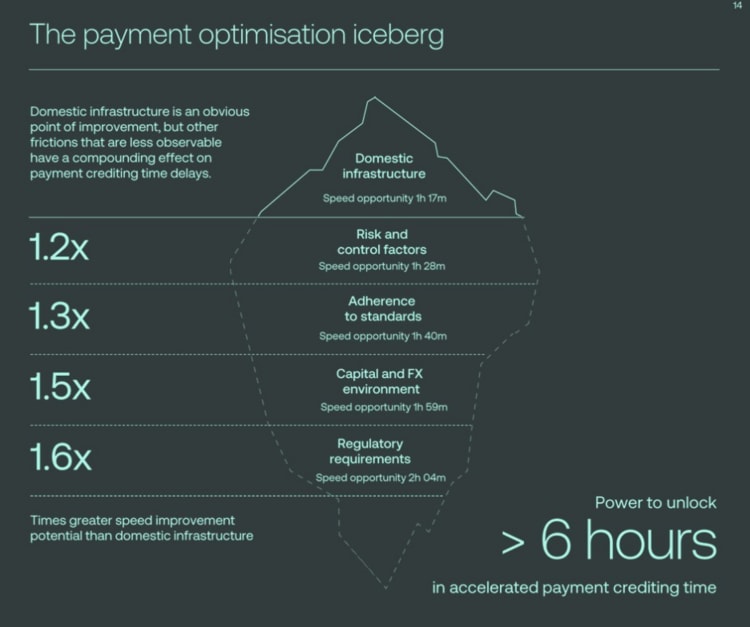
Above the waterline sit parts of the payment journey the industry can easily observe and measure: the international movement of funds, payment rails, connectivity and transaction tracking. These are tangible, understandable and often the focus of industry attention. Unsurprisingly, they’re also the areas where substantial progress has been made.
But like an iceberg, recent research shows that some of the factors with the greatest influence on payment outcomes sit deep beneath the surface—less visible, but often more consequential.
Regulatory reporting requirements, liquidity availability, foreign exchange controls, domestic market practice and data standards all influence when funds ultimately become available to customers.
If the industry's recent progress has come from improving what sits above the waterline, the next wave of optimisation may depend on better understanding what lies beneath it.
Beneath the surface: regulation
One of the most significant sources of friction beneath the waterline is domestic regulation.
This shouldn’t be surprising, as regulatory requirements exist for good reason. Authorities need information to support a wide range of objectives, from balance-of-payments reporting and tax collection to financial stability and economic oversight.
Yet how these requirements are framed and enacted can also shape how quickly funds become available to end customers.
In some markets, additional information may be required before funds can be credited. Elsewhere, payments above specific thresholds can trigger documentation requests or manual reviews. These processes support legitimate policy objectives, but they can also interrupt straight-through processing and extend the time needed to make funds available.
For customers, however, the distinction is largely invisible.
A business waiting to receive a payment is unlikely to know whether a delay stems from domestic infrastructure, operational processes or regulatory requirements. All they see is that their payment has not arrived.
This is one reason why data quality and standardisation deserve greater attention in discussions about payment optimisation.
The more efficiently information can flow alongside value, the easier it becomes for financial institutions to meet regulatory requirements without introducing unnecessary friction. The continued adoption of ISO 20022 creates opportunities to improve the consistency, quality and usability of payment data, reducing reliance on manual intervention and helping institutions meet reporting obligations more efficiently.
Regulatory oversight and efficient payment processing should not be seen as competing objectives. The challenge – and opportunity – for the industry is to continue advancing both.
Customer experience won’t come from one stakeholder alone. Progress depends on the combined efforts of policymakers, regulators, scheme owners, market infrastructures and financial institutions—all working together to reduce friction across the end-to-end payment journey.

Looking beyond the obvious
A key lesson from recent industry progress in improving cross-border payments is that success rarely comes from a single breakthrough. More often, it’s the result of identifying sources of friction and addressing them one by one.
The visible parts of the payment journey will continue to matter. Infrastructure, interoperability and connectivity remain essential foundations of a well-functioning payments ecosystem. But to continue making progress, we must address the factors that lie beneath the waterline. Many of the remaining opportunities lie beneath the surface, in the regulatory, liquidity and operational conditions that influence how quickly funds can be credited once they arrive at their destination. These frictions are not always easy to see, yet they can have an outsized influence on customer experience.
Industry players—from policymakers and standard-setting bodies to market infrastructures, financial institutions and technology providers—can all take meaningful action to reduce friction across the payment journey and ultimately deliver a better experience to end-customers. That could mean reducing unnecessary regulatory friction, improving the quality and usability of payment data, extending operational availability, or strengthening the liquidity frameworks that support cross-border flows.
After all, customers don't judge a payment by when it reaches a destination market or beneficiary financial institution. What matters to them is when the money actually lands in their account.